Coil Science 101: How to Engineer Your Perfect Vape with the Right Resistance and Materials
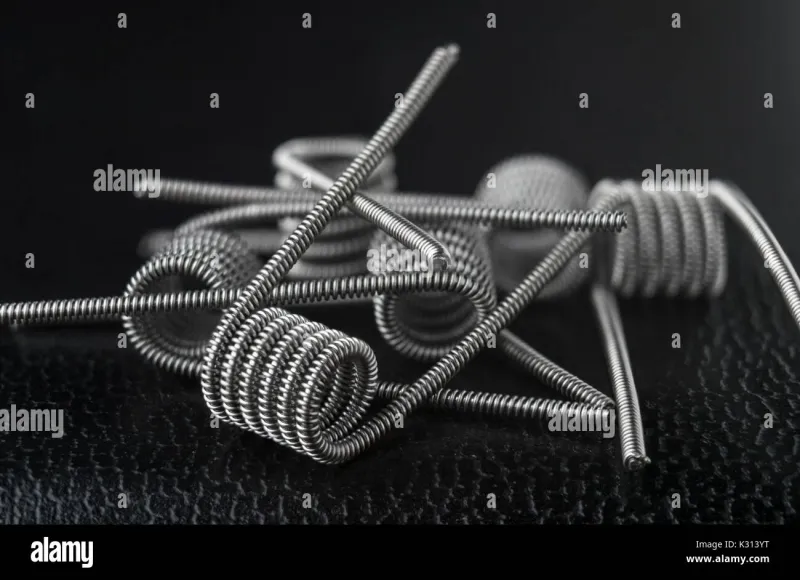
Photo: vape coil wire close up macro technical detail, via c8.alamy.com
Most people pick a coil the same way they pick a Netflix show — scroll until something looks familiar, go with it, and wonder why the experience feels a little off. If you're the kind of person who reads spec sheets, benchmarks hardware before buying, and actually wants to understand what's happening inside your device, you deserve better than that approach.
Coil technology is genuinely fascinating from an engineering standpoint, and understanding it doesn't require an electrical engineering degree. What it does require is a willingness to think about resistance, heat flux, and material properties the same way you'd think about any other performance variable. Let's get into it.
What a Coil Actually Does (And Why It Matters)
At its most fundamental level, a vape coil is a resistive heating element. When current flows from your battery through the coil wire, the resistance of that wire converts electrical energy into heat. That heat vaporizes the e-liquid saturating your wicking material, and that vapor is what you inhale.
Simple concept. But the variables involved — wire material, gauge, resistance value, coil geometry, and wicking setup — create a surprisingly wide performance envelope. Optimizing those variables for your specific preferences is the difference between a vape that feels dialed in and one that's perpetually almost right.
Wire Materials: The Foundation of Coil Performance
The material your coil is made from determines its resistance per unit length, its temperature coefficient (how dramatically resistance changes as it heats up), and how quickly it ramps up to operating temperature.
Kanthal (FeCrAl alloy) is the workhorse of the coil world. It has a very low temperature coefficient of resistance, meaning its resistance stays essentially flat as it heats up. That makes it predictable, easy to build with, and compatible with standard wattage mode on virtually any mod. It's not the flashiest option, but it's reliable and forgiving — great for vapers who want consistent performance without complexity.
Stainless Steel (SS316L in particular) is where things get more interesting. SS wire has a measurable positive temperature coefficient, which means its resistance increases as temperature rises. That property makes it compatible with Temperature Control (TC) mode on capable mods. In TC mode, your device actively monitors resistance changes to estimate coil temperature and throttle power accordingly, preventing dry hits and delivering a more consistent experience. SS also tends to produce a cleaner, brighter flavor profile compared to Kanthal.
Nickel (Ni200) was one of the original TC-compatible wire materials. It has a very high temperature coefficient, making it highly responsive to TC algorithms. However, nickel has a low melting point relative to some other materials and can be finicky to work with. Some vapers also have nickel sensitivities, which is worth knowing.
Titanium (Ti) offers a middle ground — easier to work with than nickel, TC-compatible, and with good flavor characteristics. It requires careful handling since titanium oxide can form at very high temperatures, though normal vaping conditions are well within safe operating range.
Mesh coils deserve their own mention. Rather than a traditional wound wire configuration, mesh uses a flat, perforated metal sheet as the heating element. The dramatically increased surface area means faster ramp-up time, more even heat distribution across the wick, and generally superior flavor and vapor production at equivalent wattage. Most pre-built coils in modern pod systems and sub-ohm tanks use some form of mesh geometry for exactly these reasons.
Resistance Values: Ohm's Law Is Your Friend
Resistance, measured in ohms (Ω), is one of the most directly impactful variables in your setup. Here's the practical breakdown:
Sub-ohm coils (below 1.0Ω) require more current to reach operating temperature, which means higher wattage and more battery draw. The payoff is substantial vapor production and intense, warm flavor. Sub-ohm vaping pairs well with lower-nicotine, higher-VG e-liquids. This is the territory of cloud chasers and flavor hunters who prioritize experience over efficiency.
High-resistance coils (1.0Ω and above) operate at lower wattage, draw less current, and are typically used with higher-nicotine salt-based e-liquids. The vapor production is more modest, but battery life is significantly better and the throat hit from nicotine salts is smoother. This is the architecture behind most modern pod systems and is ideal for vapers prioritizing discretion and all-day usability.
Ohm's Law — V = IR — underpins all of this. Power (watts) equals voltage squared divided by resistance (P = V²/R). Lower resistance at the same voltage means more power delivered to the coil. Your mod's chipset is constantly running these calculations to deliver consistent performance across a charge cycle.
Matching Your Coil to Your Vaping Style
Now that you have the technical foundation, here's how to apply it:
Flavor-first vapers should look at stainless steel mesh coils in the 0.2Ω–0.4Ω range, running in TC mode if your mod supports it. The even heat distribution of mesh combined with TC's ability to prevent overheating creates optimal conditions for tasting the nuances in your e-liquid.
Cloud production enthusiasts want low-resistance, high-surface-area coils — multi-strand or complex builds in the 0.1Ω–0.3Ω range — paired with high-wattage mods and max-VG juice. Expect significant battery consumption; plan accordingly.
Efficiency-focused vapers who care about battery life and portability should gravitate toward 1.0Ω+ coils in pod systems with nicotine salt e-liquids. You'll sacrifice vapor volume but gain substantially in runtime and convenience.
TC enthusiasts and data-driven tinkerers should invest in a mod with a quality TC chipset and experiment with SS316L or titanium wire. The ability to set a target temperature rather than a target wattage gives you a level of repeatability and precision that wattage mode simply can't match.
The Takeaway
Your coil isn't just a consumable — it's the core variable that shapes every aspect of your vaping experience. Understanding the engineering behind it puts you in control in a way that guesswork never will. Whether you're optimizing for flavor, clouds, battery life, or technical precision, the right coil configuration exists for your use case.
Treat it like any other spec decision. Do the research, understand the tradeoffs, and build a setup that actually performs the way you want it to.