Cracking the Code: How Temperature Control Vaping Actually Works (And Why You Should Care)
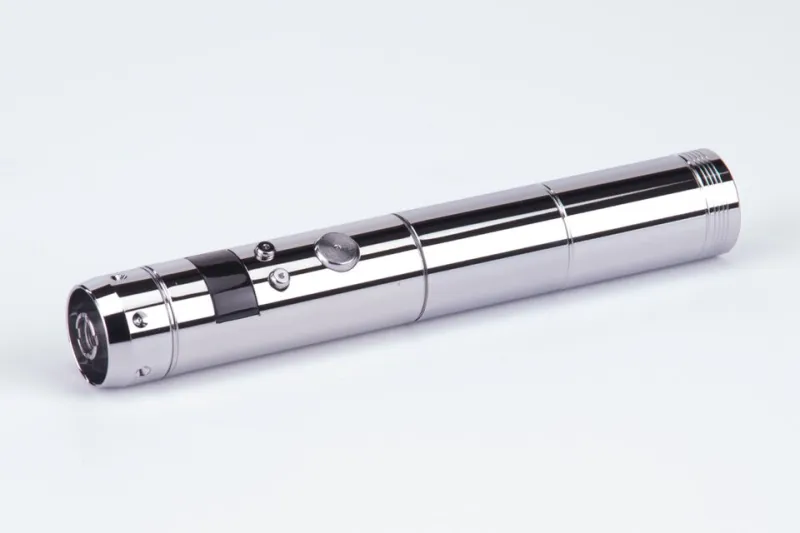
Photo: Lindsay Fox, CC BY 3.0, via Wikimedia Commons
If you've ever burned a dry hit and wondered why your $80 mod let that happen, you've already stumbled into the reason temperature control (TC) vaping exists. It's not marketing fluff. It's actual applied physics — and once you understand what's happening inside your device at the microsecond level, you'll never look at a wattage-only mod the same way again.
Let's geek out.
The Problem with Wattage-Only Vaping
Traditional variable wattage mods are simple beasts. You set a power level, the chip delivers that power to your coil, and the coil heats up. The issue? The mod has no idea what temperature your coil is actually hitting. It's essentially flying blind. If your wick runs dry, the coil keeps firing at full power — scorching the cotton, degrading your e-liquid into potentially nasty byproducts, and ruining your flavor in the process.
Wattage control is a little like driving with only a gas pedal and no speedometer. You can go fast, but you have no idea how fast.
Temperature control adds the speedometer.
The Physics Behind TC: Resistance Is Not Futile
Here's where it gets interesting. Every metal has a property called the Temperature Coefficient of Resistance (TCR) — a predictable, measurable way that its electrical resistance changes as it heats up. Nichrome (Ni80), the standard vaping wire, has a relatively low TCR, which is why it doesn't play nicely with TC. But nickel (Ni200), titanium (Ti), and stainless steel (SS316L) all have stable, well-documented TCR values that make them ideal for temperature-controlled coils.
What your TC-enabled mod is actually doing is monitoring resistance in real time — thousands of times per second. When it detects that resistance has climbed to the point corresponding to your target temperature, it backs off power delivery to maintain that exact thermal ceiling. No guessing. No overshoot. Pure feedback loop.
Think of it like a PID controller — the same technology used in industrial automation and aerospace — crammed into a device that fits in your pocket.
Why It Matters for Flavor
Flavor chemistry in e-liquids is surprisingly temperature-sensitive. Most flavor compounds — esters, ketones, aldehydes — have optimal volatilization ranges. Vape too cool and you're leaving flavor molecules behind in the liquid. Vape too hot and you're burning them before they reach your palate, turning a complex dessert profile into something that tastes like a campfire.
TC lets you lock in the sweet spot. Fruity profiles tend to sing around 390–420°F. Creamy, custard-heavy liquids usually peak somewhere in the 430–460°F range. Menthols and mint blends are often best kept below 400°F to preserve that clean, sharp note without the harshness.
These aren't magic numbers — they're starting points. Your coil build, your wick material, your airflow setup, and your specific e-liquid all interact. But having TC means you can actually run controlled experiments instead of just hoping for the best.
Setting It Up: A Practical Walkthrough
Getting into TC for the first time can feel intimidating, but the workflow is pretty straightforward once you've done it once.
Step 1: Use the right wire. This is non-negotiable. Ni200, Ti, or SS316L only. Kanthal and Nichrome will not work accurately with TC mode.
Step 2: Set your base resistance ("lock" your coil). Most mods ask you to confirm the coil resistance at room temperature before firing. This baseline is the reference point your chip uses to calculate temperature changes. Always lock resistance when the coil is cold.
Step 3: Set your temperature limit. Start conservative — around 400°F — and work your way up in 10°F increments until you hit your preferred flavor window.
Step 4: Adjust wattage (preheat power). TC mods still let you set a wattage, which controls how quickly the coil ramps up to your target temp. Higher wattage = faster ramp. Find the balance between a snappy response and a smooth, even hit.
Step 5: Fine-tune TCR if your mod supports it. Advanced mods allow manual TCR entry, which is especially useful for exotic wire alloys or mesh coils where the published values might not be perfectly accurate.
Comparing Top TC-Capable Mods
Not all TC implementations are created equal. Here's a breakdown of some standout options worth considering:
GeekVape Aegis Legend 2 — The Aegis line has always been a workhorse, and the Legend 2 brings solid TC performance with IP68 water/dust resistance. The AS-L chipset handles SS, Ni200, and Ti reliably, and the build quality is genuinely impressive for the price point. Great entry into TC for someone who wants durability alongside functionality.
Voopoo Drag 4 — Voopoo's GENE.TT chip is one of the more refined TC implementations on the market. The auto-preheat feature takes some of the manual tuning out of the equation, and the TC accuracy is tight enough to satisfy picky flavor chasers. The UI is clean, the 177W ceiling gives you plenty of headroom, and the dual 18650 setup keeps the battery life reasonable.
Lost Vape Centaurus Q200 — If you want a premium experience, the Centaurus Q200 is hard to beat. The Quest chip offers custom TCR input, a responsive firing system, and one of the smoother TC experiences in its class. The design leans premium without being ostentatious — a mod that looks as sophisticated as it performs.
Vaporesso LUXE XR Max — A pod-mod hybrid with surprisingly capable TC functionality, especially for newer vapers who don't want to deal with full-sized mods. TC performance is solid for the form factor, and the AXON chip handles SS coils well.
A Word from the Engineering Side
We reached out to a firmware developer at a major mod manufacturer (who asked to remain anonymous, as is common in the industry) to get some inside perspective. "The biggest challenge in TC is drift compensation," they explained. "Coils don't always behave perfectly linearly as they heat. The best chips account for thermal lag — the delay between power input and actual coil temperature — and adjust power delivery accordingly. That's the difference between a TC mode that feels responsive and one that feels laggy or inconsistent."
They also noted that mesh coils add complexity: "Mesh has more surface area and heats more evenly, but the resistance profile can behave differently than a traditional round wire build. We spend a lot of time tuning the default TCR profiles for mesh to make sure TC mode actually works the way users expect."
The Bottom Line
Temperature control vaping is the closest thing to having a precision instrument in your hand. Is it more complex than just cranking up the watts and ripping? Sure. But if you're the kind of person who actually cares about what you're putting in your body, what your flavor profile tastes like, and how your hardware is performing at a fundamental level — TC is worth every minute of the learning curve.
At Geek Bar Vapes, we believe your setup should work as hard as your brain does. And now that you know the physics, you've got no excuse not to dial it in.